

On May 12th, Caponnetto Hueber CTO Mario Caponnetto participated in the maritime sustainability debate hosted by Nautik Magazine at the Forbes House in Madrid, with the support of Marina Port Valencia. His contribution brought a clear and pragmatic perspective to the conversation: the future of sustainable navigation will not emerge from ideology, but from engineering, research and technological transfer.
Drawing from decades at the forefront of naval innovation—from pioneering CFD methodologies to multiple America’s Cup campaigns—Mario highlighted the unique role of competitive sailing as a true research laboratory for the maritime industry. In high-performance environments, where every fraction of efficiency matters, technologies evolve under extreme constraints before eventually finding applications beyond racing itself.
“The interesting part is transferring that technology into the real world.”
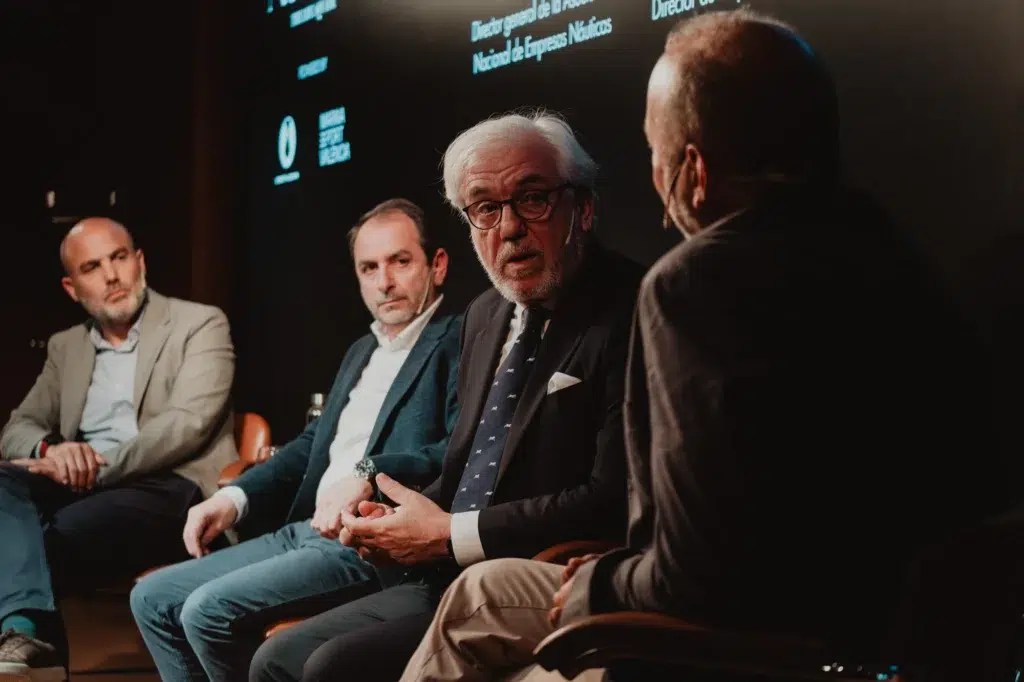
This philosophy has long been at the core of Caponnetto Hueber’s vision: transforming advanced hydrodynamic research and high-performance innovation into practical and scalable solutions for commercial and industrial maritime applications.
During the discussion, Mario emphasized the enormous potential of hydrofoils and advanced hydrodynamic design to drastically reduce energy consumption, minimize wave impact and improve vessel efficiency. A field where Caponnetto Hueber has been pioneering for years through CFD development, foil design and efficient vessel engineering.
The debate also addressed the complexity of the maritime energy transition and the need for a more realistic technological approach.
“Hydrogen is not an energy source. It is an energy vector.”
There is no universal solution for maritime sustainability. Different technologies solve different operational challenges, and the real opportunity lies in intelligently combining innovation, efficiency and industrial feasibility.

This is precisely where engineering becomes essential: not as discourse, but as a tool capable of transforming ambitious ideas into measurable performance and practical reality.
At Caponnetto Hueber, we strongly believe the future of maritime sustainability will be built through research, experimentation and the transfer of cutting-edge technologies into accessible industrial solutions.
Because sustainability without efficiency is rhetoric.
And innovation without application changes nothing.
READ MORE ABOUT THIS EVENT:
Nautik convierte Forbes House en el epicentro del debate sobre sostenibilidad marítima y transformación portuaria
Las mejores imágenes de Nautik | Maritime Sustainability en Forbes House
On May 12th, Caponnetto Hueber CTO Mario Caponnetto participated in the maritime sustainability debate hosted by Nautik Magazine at the Forbes House in Madrid, with the support of Marina Port Valencia. His contribution brought a clear and pragmatic perspective to the conversation: the future of sustainable navigation will not emerge from ideology, but from engineering, research and technological transfer.
Drawing from decades at the forefront of naval innovation—from pioneering CFD methodologies to multiple America’s Cup campaigns—Mario highlighted the unique role of competitive sailing as a true research laboratory for the maritime industry. In high-performance environments, where every fraction of efficiency matters, technologies evolve under extreme constraints before eventually finding applications beyond racing itself.
“The interesting part is transferring that technology into the real world.”
This philosophy has long been at the core of Caponnetto Hueber’s vision: transforming advanced hydrodynamic research and high-performance innovation into practical and scalable solutions for commercial and industrial maritime applications.
During the discussion, Mario emphasized the enormous potential of hydrofoils and advanced hydrodynamic design to drastically reduce energy consumption, minimize wave impact and improve vessel efficiency. A field where Caponnetto Hueber has been pioneering for years through CFD development, foil design and efficient vessel engineering.
The debate also addressed the complexity of the maritime energy transition and the need for a more realistic technological approach.
“Hydrogen is not an energy source. It is an energy vector.”
There is no universal solution for maritime sustainability. Different technologies solve different operational challenges, and the real opportunity lies in intelligently combining innovation, efficiency and industrial feasibility.
This is precisely where engineering becomes essential: not as discourse, but as a tool capable of transforming ambitious ideas into measurable performance and practical reality.
At Caponnetto Hueber, we strongly believe the future of maritime sustainability will be built through research, experimentation and the transfer of cutting-edge technologies into accessible industrial solutions.
Because sustainability without efficiency is rhetoric.
And innovation without application changes nothing.
READ MORE ABOUT THIS EVENT:
Nautik convierte Forbes House en el epicentro del debate sobre sostenibilidad marítima y transformación portuaria
Las mejores imágenes de Nautik | Maritime Sustainability en Forbes House
On May 12th, Caponnetto Hueber CTO Mario Caponnetto participated in the maritime sustainability debate hosted by Nautik Magazine at the Forbes House in Madrid, with the support of Marina Port Valencia. His contribution brought a clear and pragmatic perspective to the conversation: the future of sustainable navigation will not emerge from ideology, but from engineering, research and technological transfer.
Drawing from decades at the forefront of naval innovation—from pioneering CFD methodologies to multiple America’s Cup campaigns—Mario highlighted the unique role of competitive sailing as a true research laboratory for the maritime industry. In high-performance environments, where every fraction of efficiency matters, technologies evolve under extreme constraints before eventually finding applications beyond racing itself.
“The interesting part is transferring that technology into the real world.”
This philosophy has long been at the core of Caponnetto Hueber’s vision: transforming advanced hydrodynamic research and high-performance innovation into practical and scalable solutions for commercial and industrial maritime applications.
During the discussion, Mario emphasized the enormous potential of hydrofoils and advanced hydrodynamic design to drastically reduce energy consumption, minimize wave impact and improve vessel efficiency. A field where Caponnetto Hueber has been pioneering for years through CFD development, foil design and efficient vessel engineering.
The debate also addressed the complexity of the maritime energy transition and the need for a more realistic technological approach.
“Hydrogen is not an energy source. It is an energy vector.”
There is no universal solution for maritime sustainability. Different technologies solve different operational challenges, and the real opportunity lies in intelligently combining innovation, efficiency and industrial feasibility.
This is precisely where engineering becomes essential: not as discourse, but as a tool capable of transforming ambitious ideas into measurable performance and practical reality.
At Caponnetto Hueber, we strongly believe the future of maritime sustainability will be built through research, experimentation and the transfer of cutting-edge technologies into accessible industrial solutions.
Because sustainability without efficiency is rhetoric.
And innovation without application changes nothing.
READ MORE ABOUT THIS EVENT:
Nautik convierte Forbes House en el epicentro del debate sobre sostenibilidad marítima y transformación portuaria
Las mejores imágenes de Nautik | Maritime Sustainability en Forbes House