
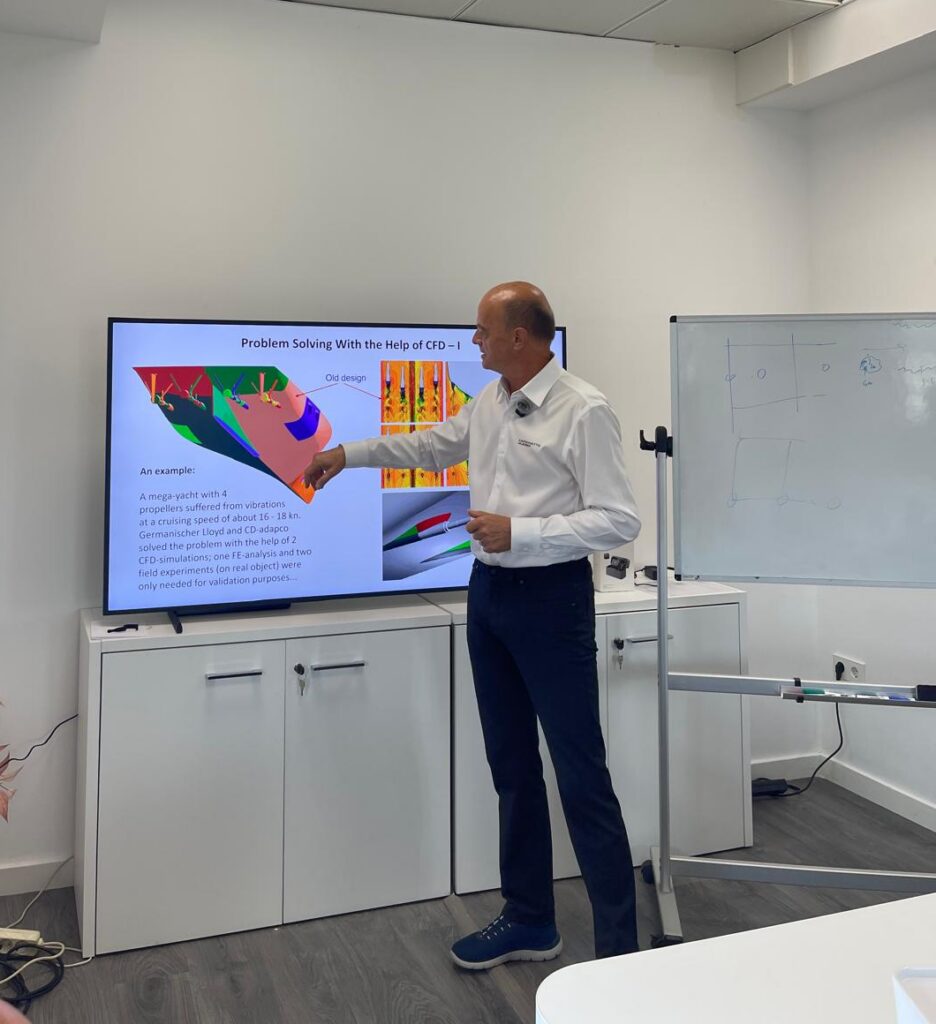
Behind every reliable CFD simulation lies much more than computational power. There are decades of scientific development, a deep understanding of fluid physics and the experience required to distinguish a numerical result from a trustworthy engineering prediction.
On October 19th, we had the privilege of welcoming Milovan Perić, Scientific Advisor to Caponnetto Hueber, to our offices in Valencia for a special technical session entitled The Art of CFD Development and Application.
The presentation brought together the entire CH team, with some of our collaborators joining remotely from as far away as Australia. The remarkable interest throughout the session reflected something deeply rooted in our company: a shared curiosity for fluid dynamics and a commitment to continuously expanding our scientific and engineering knowledge.
Drawing on more than four decades of experience in CFD development and application, Milovan guided us through the extraordinary evolution of computational fluid dynamics, from the early days of programming with punched cards and extremely limited computing resources to today’s high-performance computing environments capable of resolving increasingly complex flow phenomena.
But the session went far beyond a historical perspective.
Through practical examples from automotive engineering, marine propulsion, naval architecture and high-performance foils, Milovan explored the decisions that ultimately determine the reliability of a simulation: discretisation methods, turbulence modelling, mesh quality, numerical accuracy, convergence and the importance of experimental validation.
One of the most compelling messages was that greater computational complexity does not automatically guarantee greater accuracy. Understanding the limitations of numerical methods, identifying potential sources of error and selecting the appropriate modelling strategy remain essential responsibilities of the CFD engineer.
This philosophy is particularly relevant to our work at Caponnetto Hueber, where numerical simulation plays a central role in the development and optimisation of advanced hydrodynamic systems.
The presentation also offered an opportunity to explore the progress of our ongoing research into high-lift foil, examining the differences between turbulence modelling approaches and high-fidelity Direct Numerical Simulation (DNS).
The results illustrated the sensitivity of flow behaviour to mesh resolution and numerical methodology, particularly in demanding conditions close to stall. These investigations underline the importance of continuously questioning, validating and refining the tools we use to predict complex hydrodynamic phenomena.
For CH, this exchange of knowledge represents much more than an internal technical session.
Research is not separate from engineering excellence. It is what makes engineering excellence possible.
Our collaboration with Milovan Perić reflects our determination to remain actively involved in scientific development, challenge established methodologies and contribute to a deeper understanding of the physics behind high-performance maritime design.
By bringing together scientific expertise, advanced numerical methods and practical engineering experience, we aim not only to apply existing technologies, but also to participate in improving the knowledge and tools that will shape the next generation of maritime innovation.
We would like to sincerely thank Milovan for sharing his experience, insights and scientific curiosity with our team, and everyone who joined the session, both in person and remotely.
Our research continues. And we invite you to be part of it.
As part of our ongoing collaboration with Milovan Perić, Caponnetto Hueber has already published two scientific papers exploring advanced CFD methodologies and their application to complex hydrodynamic challenges.
These publications reflect our commitment to rigorous research, technical validation and the exchange of scientific knowledge with the wider engineering community.
Would you like to explore our research in greater depth?
Subscribe to the Caponnetto Hueber newsletter to receive our two previously published scientific papers developed in collaboration with Milovan Perić, as well as future research papers as soon as they are released.
Discover the science behind performance. Stay connected to the research shaping what comes next.
Subscribe to our newsletter and receive our latest research.
During the 33rd America’s Cup cycle, Mario Caponnetto contributed to hydrodynamic assessment workstreams aligned with the BMW Oracle wing-sail platform, the configuration that ultimately won the Match. This milestone marked the shift toward aero-hydrodynamic integration in Cup design culture.
BMW Oracle Racing
America’s Cup / Aero-Hydro Integration / Performance Engineering
In 2021, Caponnetto Hueber led the CFD, foil design, and hydrodynamic engineering for the AC75 of Luna Rossa Challenge, the eventual Prada Cup winner. We deployed multiscale CFD and aero-hydro coupling to ensure optimum lift and control. Rapid iteration delivered performance gains under tight competition timelines.
Luna Rossa Challenge
Racing Concept / CFD / Foil Design