

The catamaran is a concept roughly 4,000 years old, and yet it keeps reinventing itself.
It was born with the Austronesian seafarers, who lashed two hulls together and used them to cross the largest ocean on Earth.
Even its name remembers those beginnings. Catamaran comes from the Tamil kattumaram—»tied wood»—a phrase that captures how disarmingly simple the original idea was: bound timber, balanced and quick across the water.
When Westerners finally met these craft, what impressed them wasn’t sophistication but its absence. The speed came from the simplicity: two slender hulls, very little drag, no heavy keel to haul through the sea. It was an elegant solution that European naval tradition, fixated on the single deep hull, had simply never thought to pursue.
Perhaps that’s why, even now, the catamaran splits opinion. Some love it for its speed, its stability, its clean logic. Others can’t stand it: they find it graceless, un-seamanlike, almost a betrayal of what a «real» boat is supposed to be. Few vessels manage to divide people quite like this one.
The beautiful thing is that everyone gets to choose what they sail. And those who love catamarans—whether under sail or under power—are surely rewarded by the performance these boats can reach, and by the speeds they deliver without demanding the long, expensive hull that a conventional vessel would need to go just as fast.

It’s well known that a floating hull moving through water creates a wave whose length depends on its speed, and that above a certain critical speed the hull begins to «sink into its own wave trough» sharply increasing what’s called wave-making resistance. This speed becomes a genuine barrier when a boat is heavy for its length. But there are ways to «escape» it. With certain hull shapes, the boat can plane over its own wave. Alternatively, you can give the hull a very slender form, narrow and deep, and light enough that the critical speed is no longer a limit. The problem is that a hull this slender has no transverse stability and would simply capsize. But if you join two such hulls side by side, you get a boat that has both low resistance and great transverse stability at the same time.
This is the Holy Grail for a sailboat, where you want not only to reduce resistance but also to increase transverse stability against heeling. Indeed, the greater the righting moment, the greater the drive the sails can deliver without the boat heeling excessively. A motor catamaran, by contrast, doesn’t benefit from this righting-moment advantage. But the reduction in resistance compared to an equivalent monohull—along with other benefits tied to living space, especially on deck—are still advantages that many people know how to appreciate.

The catamaran Crossbow II held the Sailing Speed Record for many years, until it was dethroned by another invention with roots in tropical seas: the windsurf…
Reducing resistance remains a central objective in catamaran design.
However, minimizing drag can lead to compromises in:
As usual, the most efficient solution is rarely the one with the lowest theoretical resistance. It is the one that achieves the best balance between different requirements.
Unlike static calculations, real vessels operate in dynamic environments.
Changes in:
can significantly alter:
For both sailing and power pleasure catamarans, the distance between the underside of the deck and the water—the so-called tunnel—is a very critical variable, in practice limiting the sea state in which the catamaran can sail comfortably and safely. To avoid slamming, we want to keep it as high as possible, while aesthetics and the distribution of internal volume push in the opposite direction.
The hydrodynamic interaction between the hulls, and the constructive interference between the two wave trains generated at the bows, further complicate the behavior.
The good thing is that, wherever the designer draws the line between performance and aesthetics, nowadays we have CFD tools on our desktop that can quantitatively discriminate between different solutions in any sea state we want to sail in.
Similarly, very sharp bows have a natural tendency to degrade course-keeping, especially in following seas. Here too, there is no longer any excuse to design a boat that, once built, exhibits these kinds of problems.
CFD has transformed modern naval architecture. But its value is not limited to validating final geometries.
When integrated early in development, CFD enables:
Most importantly, it allows designers to move beyond empirical assumptions and make decisions based on measurable hydrodynamic behavior.
This is particularly valuable in catamaran optimization, where small geometric changes can produce sensible changes in the trim and complex flow interactions between hulls.

The surprising thing is how the scarcity that once led people to tie two logs together and venture out into the ocean could have become the foundation for a series of technological revolutions that have matured in recent years.
Oceangoing sailing catamarans paved the way for the development of super-high-performance boats such as the AC72s—the parents of the SailGP boats—and of a whole range of foiling powerboats. Behind these developments there is certainly a great deal of our work, carried out above all with CFD tools and a good measure of creativity.

Foils require large spans to be efficient, especially at takeoff and for the relatively heavier cruising boats and ferries. This has consequences that are above all structural, often requiring the use of expensive and sophisticated materials. A catamaran, given its proportions and generous beam compared to a monohull, inherently carries within it the seed to facilitate the use of large foils. Many different configurations have been developed in our offices, each one designed to meet a different and complex set of client requirements and specifications.
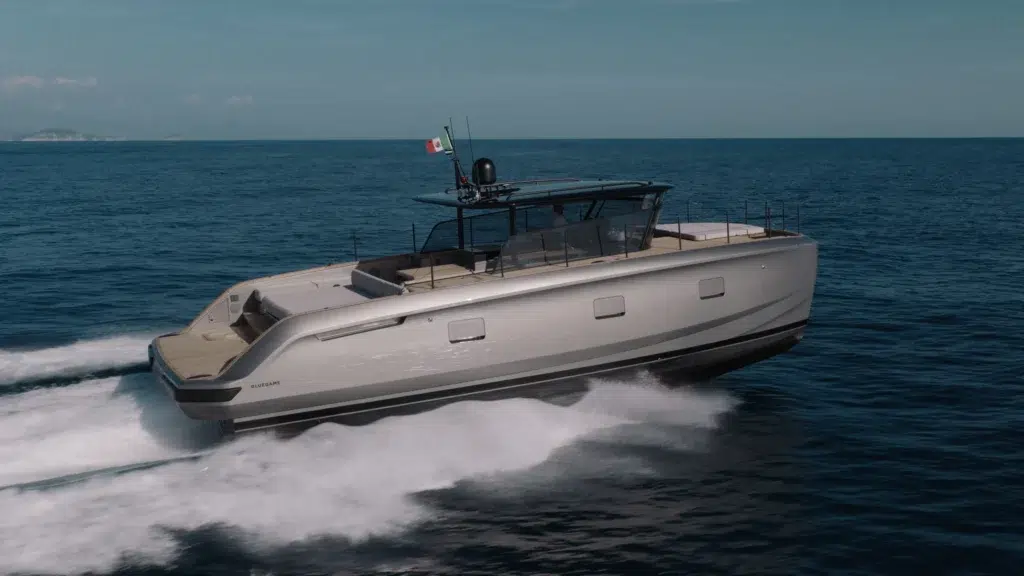
Catamaran optimization has evolved far beyond hull geometry alone.
Performance depends on the integration of hydrodynamics, propulsion, structural considerations and operational behavior into a unified design approach.
As naval architecture becomes increasingly simulation-based, the ability to understand these interactions early in development becomes a key competitive advantage.
The numerical tools available nowadays can accurately compute a wide variety of static and dynamic conditions that were once accessible only through costly experimental methods. Something that was once unimaginable for a naval architect is today widely accessible.
Because in vessel design, performance is not defined by one parameter. It is defined by how the entire system works together.
Subscribe to our newsletter to receive exclusive insights, technical content, and direct access to our latest research paper, Direct Numerical Simulation (DNS) of Flow Around a Hydrofoil: Benchmark Solution. Authored by Dr. Andrew Baglin, Mario Caponnetto, and Prof. Milovan Perić, this work delivers a high-fidelity benchmark that advances the understanding of hydrofoil flow physics and supports more accurate CFD modeling for next-generation marine applications.
 Subscribe and download HERE