
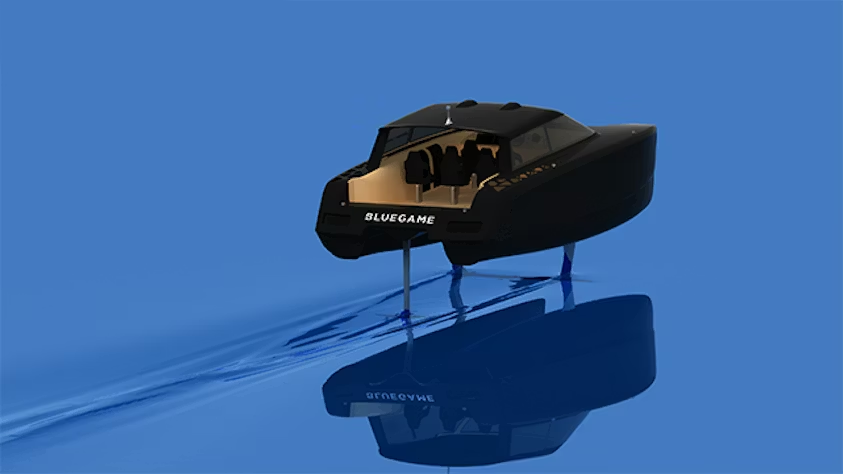
In our previous article, we explored how foiling systems must be designed as integrated platforms. The next challenge is ensuring that these systems perform as expected in reality.
In foiling vessel design, simulation has reached an unprecedented level of sophistication.
Today, CFD tools can capture complex flow phenomena, multi-degree-of-freedom dynamics, and interactions between hull, foils, and propulsion systems. Entire concepts can be developed, tested, and optimized in a fully digital environment.
Yet, one fundamental question remains:
How do we ensure that what works in simulation will work in reality?
Bridging this gap—from numerical prediction to real-world performance—is where many foiling concepts succeed… or fail.
Numerical tools are essential, but they are not infallible.
Foiling systems operate in highly sensitive regimes, where small variations can have significant consequences:
Even advanced simulations depend on assumptions:
As a result, simulation should not be seen as a final answer, but as a powerful guide within a broader validation process.
Foiling platforms operate in a very dynamic equilibrium.
Their performance depends on:
This makes them inherently sensitive to:
Without proper validation, even well-designed concepts may encounter:
Validation is therefore not a final step. It is an integral part of the design process.
Ensuring that a foiling concept performs as expected requires a multi-stage approach.
The process begins with CFD-driven design:
At this stage, the objective is not only to optimize performance, but also to understand sensitivities and potential failure modes.
Once a concept reaches sufficient maturity, physical validation becomes necessary.
Prototypes can take different forms:
The goal is to:
This step often reveals phenomena that are difficult to fully capture numerically.
Testing environments such as towing tanks or controlled trials provide a critical intermediate step between simulation and open-water operation.
They allow for:
Key aspects typically assessed include:
These tests help refine both the design and the simulation models.
One of the defining elements of foiling vessels is the interaction between hydrodynamics and control systems.
Flight Control Systems (FCS) are responsible for:
Validation must therefore include:
Ignoring this interaction can lead to significant performance gaps between theory and reality.
Ultimately, the true validation of a foiling concept happens on the water.
Sea trials introduce:
This is where the full system is tested:
And, most importantly, their interaction.
Recent trials of autonomous hydrofoil platforms have shown how critical this phase is. Moving from simulation to real-world operation reveals behaviours that cannot be fully anticipated numerically, particularly in terms of control response, stability margins and interaction with unpredictable sea states.
As illustrated in recent autonomous hydrofoil trials in Valencia , real-world testing provides essential insights that refine both the design and the simulation models.
Data collected during sea trials is essential to:
Validation is not a linear process. It is an iterative loop:
Simulation → Prototype → Testing → Feedback → Improved Simulation
Each stage informs the next.
This continuous feedback loop is what enables:
Over time, it builds a deeper understanding of complex phenomena such as ventilation, stability limits, and system interactions.
For shipyards and developers, the ultimate goal is not theoretical performance. It is reliable, repeatable performance in real operating conditions.
Achieving this requires:
Foiling is a powerful technology, but only when it is validated as a system.
Simulation has transformed the way foiling vessels are designed. But it is validation that transforms concepts into real, working platforms.
From CFD models to sea trials, the path from idea to operation is defined by one key principle:
Performance must be proven, not assumed.
Subscribe to our newsletter to receive exclusive insights, technical content, and direct access to our latest research paper, Direct Numerical Simulation (DNS) of Flow Around a Hydrofoil: Benchmark Solution. Authored by Dr. Andrew Baglin, Mario Caponnetto, and Prof. Milovan Perić, this work delivers a high-fidelity benchmark that advances the understanding of hydrofoil flow physics and supports more accurate CFD modeling for next-generation marine applications.
 Subscribe and download HERE